
Euryclade Synopsis (WIP)

Updated: Apr 10
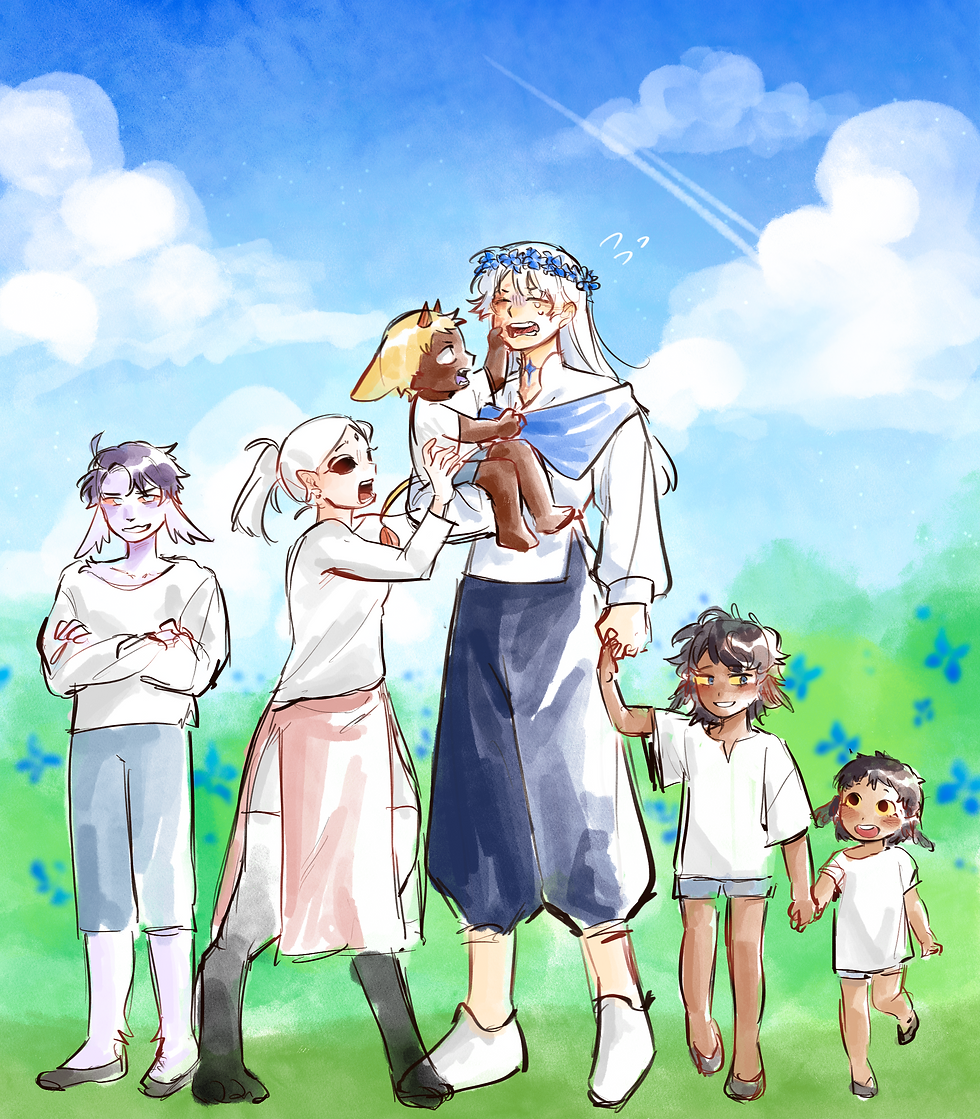
Amel in the Garden - Epilogue
Euryclade Synopsis
SETTING AND STORY ESTABLISHMENT:
The main theme of Euryclade is the development of healthy relationships: with a significant other, with family, with society, and with oneself.
The story is set in a world called “Cynthrite”, which is a planet extremely similar to Earth. All the lands are joined together within the “Cynthrite United Empire”, except for a hostile island that has barricaded itself, Euryclade. Cynthrite is divided into many states, ruled by individuals of the nobility class “Duke”. The major states within the story include: the Capitol, ruled by THE EMPEROR who rules over the entirety of Cynthrite and DESIDERIUM, AECHELON, and EWOUT, which are all governed by their namesake Duke families.
Cynthrian society is somewhat comparable to the real human world. The concept of discrimination is still present there (as we are all different, therefore we deem ourselves as unequal) – homophobia, sexism, discrimination based on economic status, and racism (not really the same as Earth’s racism but comparable to it).
In the planet Cynthrite, intellectual beings are either ‘people’ or ‘monsters’ - this is purely based on how much a species resembles humans. Humans are the species that inhabited Cynthrite along with some of the other ‘low intelligence species’, and both evolved to be able to communicate with each other. The non-human species all originated from the secluded island Euryclade. Humans have extremely high intelligence, but to adapt to the harsh fantastical climate of Cynthrite, they started to develop abilities/powers. These were passed through blood, and soon humans became interspersed into different species, that became less and less resemblant of the traits humans had. Pure blood humans became extinct. Low intelligence species also began to breed with these species evolved from humans, resulting in certain low intelligence species also developing powers.
Higher intelligence beings believe that the human form is the most perfect form to be, because they were the most intelligent. They also received the most powers/abilities, which made them have an advantage over low intelligence species intellectually and ability-wise, but low intelligence species still harbored great physical strength, making them feared. Both species feared each other, and were disgusted by each other. As the more intelligent group, humanoids coined the derogatory terminology of “monster” to denote those that physically resembled low intelligence species. So became the ‘divide of species’: a system created by people to differentiate themselves from those they believed were less than them.
The discrimination between people and monsters is comparable to the societal hierarchies within our real human society. The blatant discrimination between people and monsters is comparable to racism within human societies. Regarding homophobia - the planet Cynthrite is not a theocracy, and Christianity does not exist as a whole. However, homophobia is present within Cynthrian society as it is interconnected with racism. Homosexuality is oftentimes associated with the low intelligence species, because some of their species reproduce in ways that are considered ‘abnormal’ for the humanoids (not male-female sexual reproduction). Therefore homosexuality is looked down upon, since to people that have established racism towards monsters, it seems like an act of lowering the status of the proud humanoids.
As time passed, mutations of abilities became increasingly more prominent, until at one point, certain mutations made it so that individuals do not harbor any abilities. All humanoids and monsters are born with pitch black eyes, but slowly start to have defined iris colors and pupil patterns once they reach a certain age. The Powerless (term not yet finalized), however, do not experience this change.
Since the absence of ability is evidence of mutation through “cross-breeding”, and since the powerless are defenseless, being without any special ability to save themselves, they are considered the scum of society. They act as a scapegoat for both humanoids and monsters: as for the humanoids, the powerless are the living examples of the consequences of “cross-breeding”, and as for the monsters, these are the few people that are actually ‘weaker’ than them, who usually resemble the humanoids that are always so dismissive of the monsters.
After the CUE was established, the development of a social class hierarchy also followed. This hierarchy follows the names of European peerage noble ranks: Duke, Marquis, Count/Earl, Viscount, Baron, Baronet, Knight, Commoner, Lowborn in descending order. Dukes control and manage the “states”, while the nobles run smaller cities and lands under the dukedom. Dukes receive their “formal name” from the Council & Emperor once anointed, and their childhood name usually becomes a middle name, concealed from the public, allowed only to those that are close to the duke.
Keep in mind that nobility in Cynthrite is not necessarily followed by blood, and the importance of being linked by blood is less valued than being linked by ability or quirk. It is surprisingly common for nobles to adopt children with strong abilities/similar abilities to them and make them their heir if they aren’t planning to have children
As time passed, the discrimination between humanoids and monsters worsened, with traits of rationality, emotional intellect, morality and nobility being associated with humanoids while monsters and those with more monster-like traits became associated with barbarism, violence and aggression. To make matters worse, Emperor TYRHA CYNTHRIEN, who had been the first CUE Emperor’s heir, made an inter-union law – the Species Identifier law – that people must never conceal externally visible traits that are common within their species. For example, if a species is known to have wings, it would be illegal for people to wear clothes that completely cover that external trait. This basically criminalized mixed-species intercourse as a secondary effect, as people that do not fall cleanly into the binary of the officially classified and recognized species of the CUE would, in their existence itself, pose an issue to the Species Identifier law.
Euryclade is divided into two large “Arcs”, with the 3-year time gap between acting as a period where the main characters are separated from each other and are forced to grow in their own respective ways.
ARC 1 ESTABLISHMENT:
The year is 898 A.U. (After Unity). The Emperor, TYRHA CYNTHRIEN (he/him), along with the Council, had made multiple attempts to explore and colonize Euryclade, but these attempts had all failed.
***One notable attempt is the Ewout—Euryclade expedition that happened in 893 A.U.. After a revolution happened in Ewout, CECILLIA CECIL EWOUT (she/her) became the new duke and ruler of the region, Due to the unstable political climate of the state at the time, the Duke of Ewout had to heed by the Emperor’s every order to avoid further unnecessary conflicts and issues. She agreed to go on an expedition to assess the situation in Euryclade after 50 years had gone by since the island had been used as a place to exile/execute felons in exchange for funds that would go towards creating a better financial environment for commoners. The Duke, a majority of the Ewout Knights’ first division, as well as the duke’s fiancé and leader of the first division, ECLIS SCHNENWEIER (he/him), went on the mission together. The details of this expedition are not revealed at the start of the plot, but it is established that the attempt was a failure – only the duke and Eclis returned from the journey. Cecillia fell into a coma due to multiple accumulated wounds, and her assistant and close friend, Marquis JADE PANESITA (she/her), took over the duties of the Duke Ewout. The discrimination towards monsters and the public’s preconception towards the island worsened after the event.
The Empire had still been sending non-animate devices and such to see what was happening in the island. There had also been some extremely lucky agents from the Council that had been able to infiltrate some of the remote villages on the outskirts of Euryclade. Over the years, reports of a strange phenomenon arose; rumours of “wishing stars”, or “lehels” as the Council called them, that came out of the remains of distorted monsters on the island was sweeping over the villagers. These lehels were thought to be able to grant any wish the finder of it had. Along with this phenomenon, undercover agents also noted the formation of a new organization called the “Iftelle”, which had been quickly taking over central Euryclade (that was difficult for the agents to get to due to the harsh climate). The Iftelle showed signs of spreading anti-imperialist and rebellious propaganda, and the assumed rate of growth of the organization was becoming alarming.
Taking the multiple failed attempts into consideration, the Emperor orders for there to be one final expedition to Euryclade in order to investigate the lehel situation as well as the Iftelle. The members chosen to go on this mission would be minor criminals/felons that had once been useful to their respective states. This final expedition would be a last chance for both Euryclade and the four people chosen to go on the mission to prove themselves to be redeemable/useful to the Empire; as the Emperor planned to wipe the island itself off Cynthrite if proven to be too dangerous or hostile this time.
The quad chosen to go on the expedition, the main characters of Euryclade, are as follows:
AMEL (AMELAIDE) DESIDERIUM (she/they), the younger sister of the Duke ZRAYUU ARWEN DESIDERIUM (she/her), had been incarcerated, charged with committing arson as an attempt to harm two Council members. She conceals this at the start of the story, but she had actually taken the fall for her older sister, whom had committed the crime in response to getting severely insulted by said Council members. The two sisters have a strained relationship, as they used to be extremely close in their childhood years before Zrayuu suddenly started distancing herself from Amel. Zrayuu draws a clear line between the two of them, pushing their relationship to be more corporate than familial, becoming extremely cold towards her. Amel is obsessed over being accepted and loved by her, reminiscing the happy and healthy relationship they used to have. She believes Zrayuu will love her again if she proves herself to be useful. As a final attempt to validate herself in the eyes of her sister and potentially salvage their relationship, Amel agrees to go on the expedition.
XEMU HOLT (he/him) is a member of an information-gathering underground guild, Xeros, working for the Duke XERSIAN YUN AECHELON (he/him). The dominant species inhabiting Aechelon are humanoids with red horns that protrude straight up from the top of the head. This species believes their abilities originate and are ‘charged’ within their horns, so well-maintained, ‘beautiful’ horns became an indicator of high social status. Additionally, these horns contained medical value – consuming them could heal any injury (depending on the “quality” and quantity of the horns), adding to the importance of the trait. Xemu had hidden the fact one of his horns were broken, using a gifted prosthetic to cover it up, when he was admitted into Xeros. When this was found out, the higher-ups of Xeros detained him, and, in the absence of the Duke Aechelon (as he was out of the state for a business trip), offered him for the Euryclade expedition. The higher-ups give Xemu a choice: if he were to return from the Euryclade trip, they would dismiss the violation of the Species Identifier law and secure his position within Xeros.
Eclis Schnenweier is a Viscount of Ewout, as well as the knight and fiancé of the Duke Ewout (Cecillia Cecil Ewout). After the failed Ewout–Euryclade expedition, Eclis isolates himself from everything and everyone, becoming negligent towards his obligations as head knight of the Ewout Knights’ first division. Although Marquis Jade Panesita, a friend of both the Duke and Eclis, tried to get him back on track, he continued to ‘fail’ his position, slowly earning the title of the “Slothful Knight”. One particularly gruesome outcome of his sloth came in the form of 7 knights being severely injured and one casualty on a mission appointed by Jade. Unable to defend him any further, Jade keeps Eclis detained in solitary confinement, until the Council starts pressuring the state of Ewout to “fulfil their duties as part of the CUE” again. An unnamed member of the Council specifically suggests for Eclis to go on the expedition as a way to redeem his actions, and Jade unwillingly accepts this decision. Eclis reluctantly sets foot to return to Euryclade, where he had once lost everything.
NUA (NUA INDIGO) (she/her) is an android-turned-humanoid who has no recollection of her past as a person, only the faint recollection of her creator’s gentle touch before waking up in a deserted laboratory. She was the failed product of the discontinued Project ASCLEPIO by Coronis, a government-funded laboratory that abruptly disappeared off the face of Cynthrite a few years back. As the project was abandoned before it could be finished, the Council was unsure of the safety concerns regarding Nua’s existence. After conducting a few experiments with Nua’s combat ability, they figured the best way to put her to use would be the Euryclade mission. Nua is given orders to assist the other three members of the mission, threatened with being discarded if she does not prove her worth.
The story starts off with a somewhat light-hearted tone, as the four main characters slowly adjust to their chaotic life in the outskirts of Euryclade. There is an overall uncomfortable air in the atmosphere, as all four characters know that this was basically a death mission even as the more light and joking episodes play on.


Comments